Tag: Virtual Work


by Gary McGillicuddy, Birches Group Managing Partner

In the 1980s, a movie was produced, Quest for Fire. The movie tried to depict the conditions in which early humans lived some 80,000 years ago. Needless to say, it was not a pleasant existence that was presented. Humans lived in pre-language tribal communities. On all sides, they were beset by challenges and outright dangers from the environment, wild animals, and, of course, fellow man.

The formation of tribal communities was simply borne of necessity. Survival hinged on collective activities to gather the necessary provisions and to stave off the dangers that surrounded them. The level of knowledge to engage more effectively with their surroundings, as depicted in the movie, was quite limited. Core to the plot was the need to get fire. For early humans, fire was a gift from the Gods, generated by violent storms. There was no understanding of how fire was made; all that mattered was the
uses to which fire could be put, and how devastating it could be to lose this vital heavenly resource.

In the movie, due to an oversight in vigilance, the tribe’s fire was accidentally extinguished in a rainstorm. It was decided that the two stronger men would go on a quest, a Quest for Fire. Hoping to possibly steal fire from another tribe, the men proceeded to cross territory utterly unfamiliar with unknown dangers. Wild animals stalked them, the elements harassed them, and they were under constant threat from the very people from whom they were hoping to steal.

Survival against these conditions entirely depended on teamwork, the pooling of observations leading to the progressive building of knowledge. In their quest, yes, the challenges of survival were largely dependent upon strength and luck. However, along the way, the movie shows us what separates man from the rest of the beasts in the field. We are not solely reliant on instinct; we can observe, adapt, and learn. In the quest for fire, the initial goal was to steal it from another tribe since, of course, you cannot recreate a gift from the gods. But can you? Stealth and observation give the opportunity.

Two people dressed as prehistoric humans sit by a small campfire under a rocky overhang at dusk, surrounded by trees and wilderness.

Humanity is driven, or as some have thought, condemned to an endless quest for knowledge and all that brings. We are not content with seeking a harmonious life in the natural world.

Finding the Spark

In the quest of this team, it came down not to stealing but learning. With a little friction and dried wood, you could create a spark; the rest follows from that moment. This success in the quest, of course, was not just the knowledge to create and harness fire; it was the power this knowledge brought. Humanity is driven, or as some have thought, condemned to an endless quest for knowledge and all that it brings. We are not content with seeking a harmonious life in the natural world. Since our expulsion from the Garden of Eden because we ate from the tree of knowledge, we have no choice but to pursue knowledge. Fundamental to sustaining our frail existence, we need to use our brain power to control the world around us through understanding this world and how we fit in. Beyond addressing individual challenges to our existence, this has led to a deeper introspection as to our purpose and what that means for the communities in which we live. From St. Augustine, who asserted our purpose must be to build the City of God (De cogitate Dei contra paganos), following the sack of Rome in the fifth century, initially, the adoption of Christianity had weakened the empire by turning away from Rome’s traditional gods. St. Augustine argued that the sacking of Rome was the result of a focus on material wealth. He set forth that the focus of society must be to build the City of God as opposed to the City of Man.

Thomas More, in his work Utopia, articulates a view of society that rests on a collective view and supports a world built on the rule of law, as what today would be an early socialist model, where private property does not exist. Utopia reflects 16th-century humanist thought, also linked to ancient views of society by Plato. Here, humans set the rules and can shape society to their goals. In Utopia, the pursuit of leisure and pleasure is a central tenet of society.

Putting the Models in Place

Whether with a spiritual or humanistic focus, it is about how to shape and advance community. From our two travelers seeking fire, this was for the well-being of their camp. This long story of how and why we try to grow our knowledge, regardless of its objectives, is pursued from a collectivist perspective. The structures advanced by St. Augustine and Thomas More were used to guide several examples of new communities. Most notably, such movements were pursued seriously in the 19th century in America.

Roman soldiers and civilians clash in a chaotic city street filled with fire and smoke, as a golden chariot is wheeled through the destruction amid burning buildings.

Two good examples are the Shaker movement and the Oneida experiment. While both had a strong religious foundation, the communities that they established were quite different. The Shakers espoused a simple lifestyle that focused on practical utility and communal responsibility. Men and women lived separately and strictly practiced celibacy. The model was very successful, and dozens of Shaker communities sprang up across the United States. The basis of the Shaker economy came under threat through advances in technology and manufacturing, following the Civil War, when their highly refined handmade approaches could no longer compete. Communities began to dissolve, and with a decision to no longer admit members, the rule on celibacy made the disappearance of the Shaker movement a certainty.

Conversely, the Oneida experiment, which began in 1848, promoted a different communal model. In their effort to create “heaven on earth,” they promoted open and shared relationships. They practiced “complex marriage,” where all members were married to each other. The Oneida community continued for thirty-two years, and while many sought to join the community, social pressures on the morality of the community ultimately led to its breakup.

Unlike the Shakers, the Oneida Community was successful in a number of industries. Most notably, as silversmiths, the Oneida business exists to this day. They were successful in transitioning both socially and business-wise to continue their economic success. Interestingly, in both the Shaker movement and the Oneida experiment, women worked in much more equal positions with men, reflecting the shared philosophy of communities of shared responsibility.

Illustration of the Oneida Community in the 1800s, showing people gardening, woodworking, tending children, and communal living in a rural setting with large red brick buildings.

Finding the Secret of Success

Both the Shakers and the Oneida community initially built successful economic models based on the idea of communal ownership. Both St. Augustine and Thomas More envisaged societies organized around communal ownership. Oneida went on to greater success by recognizing that enduring success needed adaptation and accepting the self-interest of its members to accumulate wealth. What the Shakers and early Oneida members did not embrace, and what our initial two questers for fire learned, is that knowledge not only brings possibly wealth, but also power.

Yuval Harari, in his recent book, Nexus, examines the evolution of information networks from the Stone Age to the present. He effectively argues that the growth of information does not support a linear evolution of knowledge, which builds and deepens understanding and the building of shared consensus. Belief systems are paired with information and support the desire to act. While the Shakers and the Oneida community were quite successful in their work, it was a strong belief system that enabled these achievements for a small community. But at the same time, these beliefs ultimately led to their failure. Harari demonstrates that mythologies that lead to the creation of bureaucracies are essential, but also possess the seeds of their own demise. Information not only informs, it challenges, and as often as not generates resistance as much as inspiration.

So how can we advance in our quest for fire? The continued massing of information is the starting point, but must be accompanied by the context of our belief systems, which both spur action while also accepting “truth” in balanced and progressive doses. Too many leads to backlash, too few leads to stagnation and progressive irrelevance.

Getting to Our World and the Role of HR

Working on development and all the topics this broad category encompasses does, in fact, rest on our mythology, leading our methodologies, which we call multilateralism. From the hard lessons of World War II, a consensus emerged that cooperation is perhaps a better way to pursue inter-state relations and may be worth trying. A great and extensive network of organizations and programs was built on the tenets of the religion of multilateralism.

This has led to a widespread adherence to these tenets, the belief that progress in the evolution of humanity can only be realized through committed, and yes, unquestioning acceptance. And yes, questioning its utility is confronted not with logical counterarguments, but declarations of heresy or worse. These challenges today have been a long time coming and do present a threat to the church of multilateralism as much as Luther did to the Catholic Church through the posting of his ninety-five theses on the door of the church in Wittenberg.

The Reformation, which sprang from Luther’s actions, yes, threatened the Church but, in the end, strengthened it. The resistance to science and knowledge gradually lessened. Recommitment to mission and basic principles as follows. This is what the church of multilateralism desperately needs today, over the clutching of our rosary, praying that all this will pass soon. Let us embrace what makes multilateralism work and the best way to address global challenges, and accept that it is a messy process that needs to be held to account much more.

Whether with a spiritual or humanistic focus, it is about how to shape and advance community.

We are Globalists

Multilateralism is by definition a global perspective. This is not only because it is nice to be global, but there are also distinct advantages that come from integrating diverse perspectives and capacities. There have been many successes that have come from taking this approach that have led to significant progress in poverty reduction, health, education, protection, and human rights. The list is long and should never be diminished in its value.

At the same time, the fundamental weakness of multilateralism, the need for consensus to support collective action, needs to be re-examined. Yes, the mythology of multilateralism led to the formation of great and now lumbering bureaucracies. Putting the international agenda in the hands of these bureaucracies has led to the inevitable lumbering responses. It has bred an industry driven by process and court protocols, and is not getting on with it.

United Nations Security Council members sit at a large round table, several raising their hands to vote during a formal meeting.

There are possibly better models. The size of classic institutions has, at the same time, led to their failure. It is now time to look much more closely at some of the models that have performed well. Looking at the example of the Global Fund to fight AIDS, Tuberculosis, and Malaria is worth considering. The Global Fund is essentially a funding agency to pursue global priorities on these diseases. It does not maintain a network of field offices and the big bureaucracies accompanying program delivery. It seeks funding partners at the country level, best positioned to be successful at the community level. There are other examples of funding entities, such as the Gates Foundation and the Millennium Challenge Corporation, seeking effective implementation partners that can tailor the global agenda to meaningful local impact. The evolution of the United Nations Common System started with policy and technical secretariats. Over time, the system transformed into a large bureaucracy, with staff deployed to more than 600 locations across the planet. The demands to maintain working infrastructures that support such a massive reach are daunting. And of equal impact, it creates mindsets that the program goals morph into bureaucracies focused on ever greater growth. Examining performance and effectiveness becomes secondary to validating the status quo and sustaining career ladders.

From the HR perspective, what is the challenge that keeps large organizations from moving to a more flexible approach? This poses a significant threat to these approaches, which have remained largely unchanged from the 1970s. HR should bring insight into workforce formation and management essential to achieving the institutional mission, as opposed to the survival of the existing bureaucracies. In a world where multilateral programs are pursued much more with an increasingly widening network of specialized organizations seems to be the promise of improving impact and bringing value. We can see examples of these nimbler partners that combine new structural approaches with highly focused programs. In this edition of the Community Magazine, we are featuring a wonderful, small, yet very impactful organization, Amplify Girls. What makes Amplify Girls so representative of a new way to pursue a quest for fire is that they have embraced what our inevitable future is, working primarily as a virtual organization.

Where time and presence are no longer defining features of employment, it forces an organization to value skills, promote learning, and break down classic grade structures to milestones of capacity, where staff can advance as skills growth warrants.

Our Inevitable Future

Organizations, both public and private, have been moving gingerly into more forms of virtual work. The impact of the Covid pandemic was seen as a possible catalyst. However, now that the pandemic has passed, there has been a significant retrenchment in virtual work options. Most organizations take some pride in offering a thin gruel of virtual work, enabling a day or two a week to work from home. This is hardly a new working model, and effectively does not change the fundamental nature of organizational structure. It remains a model of control over facilitation and is a minimal nod to the increasing demand for workplace flexibility.

In 1995, Dave Ulrich, together with Ron Ashkenas, Todd Jick, and Steve Kerr, published The Boundaryless Organization. The book presented a challenging assessment of classic organizational structure, examining structural features from hierarchy to function and geography. While these classic divisions are deeply embedded in organizations and their culture in the modern world, this approach and its accompanying mindset will impede evolution in ways that capture new working realities.

In this updated edition, the boundaries of time and place have been added to the list of features that organizations must strive to overcome. Allowing staff to work from home two days a week is not a virtual approach. These policies perpetuate the classic limits of geography and hierarchy. Presence and input are still the defining features of how work is organized. It really is time to let go and become truly virtual, meaning anywhere, anytime.

A collage shows five people in different countries on a video call, each in a home office with clocks displaying local times and city landmarks visible through windows.

Yes, there are factors to overcome, but most of these are traditions. When the benefits of a truly virtual organization are embraced, the advantages become overwhelming. The simple capacity to reach talent anywhere and avoid the costs and family disruption of expatriation alone merits this approach. While asynchronous work requires a sense of responsibility and understanding how your work supports the larger endeavor, an asynchronous organization essentially can be working in a much broader time footprint, expanding productivity and client support. Yes, in a virtual organization, the workday may need to stretch to engage across time zones. Early morning and evening engagement with colleagues will become the norm. The virtual environment, at the same time, promotes a greater level of accountability and responsibility for each team member. Where time and presence are no longer defining features of employment, it forces an organization to value skills, promote learning, and break down classic grade structures to milestones of capacity, where staff can advance as skills growth warrants.

To build such a world, the challenges and the need for creative thought on the part of HR have never been greater. More than a quarter of the way into the 21st century, it is high time we shed the lingering organizational models of the past. Like our two team members who crossed new territory in a quest for fire, our quest needs to bring together a global effort. Cost-effective, enabling diversity, facilitating a focus on outputs, enabling work-life balance, facilitating gender balance, enabling a focus on results and pay for performance, and capturing the generational perspective of the future of work, do we need to say more?1

HR should bring insight on workforce formation and management essential to achieving institutional mission, as opposed to the survival of the existing bureaucracies.

1 The Shakers wrote a famous hymn, It’s a Gift to be Simple. This melody formed the basis for Aaron Copland’s Appalachian Spring.

Man with a gray beard wearing a light blue blazer, striped shirt, and a dark blue bow tie, facing the camera.

Gary is a founder and managing partner of Birches Group, based in New York. He provides executive leadership to the firm. Gary specializes in Organization Design, including Job Design, Skills Assessment, and Performance Management, and has led large-scale projects for many of our clients in these areas. Gary is the primary designer of our Community™ methodology, and an expert on the history and evolution of work. Before forming Birches Group, Gary had a long career with the United Nations Development Program (UNDP), where he was responsible for compensation and HR policy.


When teams are distributed, the informal signals that managers traditionally relied on in offices disappear. There are no hallway check-ins, no passive visibility into effort, and no shared daily rhythm. Research on remote performance management is clear that distributed teams succeed when performance is built on clear, consistent, and transparent job-based standards rather than proximity or
presence. Yet many organizations have not made this shift.

Managers still default to activity monitoring, hours logged, and response times as proxies for contribution, which introduces both bias and inequity. For teams spread across time zones, this creates a two-tier system where those who are most visible due to geography or schedule are perceived as higher performers, regardless of actual output.

Person participating in a video conference call, with nine diverse people displayed on a computer screen in a virtual meeting.

Why This Matters

When distributed teams lack clear, transparent standards for what good performance looks like, decisions about pay, promotion, and recognition default to familiarity and proximity. This is how location and schedule become informal proxies for merit, and how inequity compounds across a distributed workforce.

A job-anchored approach to performance addresses this directly: when performance standards are tied to the actual expectations of each job level rather than to personal traits or manager impression, they travel across locations, time zones, and working arrangements without losing their meaning or consistency. Organizations that build performance around what the job requires and assess it through multiple perspectives, including peers and stakeholders, create systems that are credible and fair regardless of where someone sits.

What You Can Do

  • Anchor performance standards to the job, not the person. Define what good performance looks like at each level in terms of the work itself: the ideas an employee is expected to generate, the collaboration and responsiveness their role requires, and the reliability of their delivery. These standards should mean the same thing whether someone is in headquarters or working remotely across a different time zone.
  • Move toward multi-rater assessment. In distributed settings, a manager’s line of sight is limited. Incorporating input from peers, direct reports, and internal or external stakeholders gives a fuller and more accurate picture of how someone is actually performing and reduces the bias that comes from visibility alone.
  • Audit whether reward and recognition decisions are aligned with performance data. If patterns emerge by location, time zone, or work arrangement, that is a signal that the system needs adjustment.

Despite high-profile return-to-office (RTO) mandates from Amazon, JPMorgan Chase, and Dell, the data tells a more measured story. Hybrid work remains the dominant model, with 67% of organizations still operating on hybrid schedules and 22% of workers remaining fully remote. For employees, flexibility has moved from a perk to a threshold requirement.

A 2025 Pew Research Center survey found that 46% of remote workers said they would be unlikely to stay with an employer who ended flexible arrangements, rising to 61% among fully remote workers. The equity costs are also measurable: a 2025 TIME analysis found that more than 212,000 women aged 20 and over left the workforce since January 2025, with RTO mandates and rising childcare costs cited as key drivers.

A spacious, modern office with rows of empty desks, computers, office chairs, and various office supplies, under bright fluorescent lighting.

Why This Matters

RTO mandates are not just a culture question; they are a workforce composition and equity question. Research from MIT Sloan shows that mandates do not improve financial performance but do increase attrition, especially among high performers and those with caregiving responsibilities. For organizations operating across multiple geographies, the more pressing question is not where work happens but whether policies are consistent, fair, and clearly justified to employees regardless of location.

What You Can Do

  • Audit your current work location policies to assess whether they are applied consistently across roles, levels, and locations, and whether the rationale is documented and communicated.
  • Use employee climate surveys and pulse checks to assess how flexibility policies are experienced across different employee groups, paying attention to patterns by role, gender, caregiving responsibilities, and location. What employees say about fairness and access is as important as what the policy says on paper.
  • Shift the management conversation from attendance and visibility to outcomes, establishing clear, grade-specific performance standards that work regardless of where someone is sitting.

Moving organizations towards virtual work environments is progressing in fits and starts.  After the COVID-19 pandemic, many scaled back work-from-home policies. While virtual work presents challenges, it also offers opportunities for greater efficiency, cost-effectiveness, and reach—advantages traditional workplaces often cannot match.

In this issue of Community Magazine, we explore a fundamental question: Does a workplace still need to be a place?

From its inception, AMPLIFY Girls was intentionally designed as a virtual organization. By embracing a virtual structure from the start, it has operated efficiently while expanding its reach cost-effectively, allowing the team to focus on making a virtual organization work.

A person wearing a black polo shirt with the Amplify logo stands indoors, facing the camera and smiling.
A woman smiling at the camera is seated in a modern, warmly lit room with wooden walls, a fireplace, large window, and plants.

Zack Fowler and Lucy Minayo are co-CEOs of AMPLIFY Girls, bringing a collaborative leadership style to guide the organization’s strategic growth. Together, they share a passion for amplifying the voices of community-driven organizations serving adolescent girls.

Zack has two years as Head of Strategic Partnerships at AMPLIFY Girls and is a seasoned nonprofit professional with experience in gender, health, and education initiatives across four continents.

Lucy is a human rights lawyer with over twenty years of experience in the development sector. Before joining AMPLIFY Girls, she served as Executive Director of NurtureFirst, a global funder and capacity-builder for home-based childcare providers.

Source: www.amplifygirls.org/

Q: The decision to be, from the outset, a virtual organization is unusual. Why did the governance of AMPLIFY Girls take this avant-garde step?

(Zack): Working remotely was never really a choice for us; it was a necessity. We set out to build an international team that brought together deep expertise and lived, on-the-ground experience. That meant having team members based in Africa to help shape strategy for African organizations, while also drawing on the networks, experience, and access to resources of early contributors in Canada and the United States. Given these goals, a remote structure was the only way to ensure all those voices were in the room.

Q: Adopting a virtual approach can be controversial. What were the main concerns and opportunities, and how were they addressed?

(Zack): I don’t think we ever considered anything other than this.

Q: As a virtual organization, HR must approach workforce formation differently. How do you communicate this to candidates and onboard people virtually?

(Lucy): This approach isn’t unique, particularly in the African development context, where remote work has become the norm. As a result, we haven’t faced challenges in presenting this model to potential colleagues or team members at AMPLIFY Girls, and it aligns well with broader trends among funders.

These conversations have been relatively straightforward, and the flexibility of the model is a strong draw. When engaging potential collaborators, we emphasize the opportunities that flexibility creates, which has helped us build a diverse and dynamic team we’re excited to work with.

Q: In terms of reaching talent, how has being virtual extended or impeded this reach?

(Lucy): Virtual work hasn’t impeded our ability to reach talent at all. If anything, it’s expanded by removing geographic limitations and allowing us to focus purely on finding the best people for the role, regardless of where they’re based.

(Zack): Our East Africa team is spread across Kenya, Uganda, and Tanzania. For example, our Head of Communications is based in Uganda—not because we relocated the role there, but because the strongest candidate was already there, and our model allowed us to hire without geographic constraints.

Q: Similarly, how has being virtual affected the organization’s staff demographics in terms of gender and geographic diversity?

(Zack): From a gendered, feminist perspective, remote work is a powerful driver of accessibility—especially for women at different stages of their careers or family lives. I’ve seen this firsthand throughout my career, having worked remotely long before AMPLIFY Girls.

Many women step away from the workforce to have children and later face barriers to re-entry. Remote work offers the flexibility that makes returning possible, allowing us to recruit mid-career women who are ready to re-engage but may not be able or willing to commit to rigid hours and long commutes. Several of these women have become exceptional members of our team—talent we likely would have missed if in-office work were required.

(Lucy): There’s also another side to this conversation: remote work creates an opportunity to challenge gendered narratives about roles within the home. It opens space for a more equitable sharing of family responsibilities and makes those shifts more visible and achievable.

In this sense, remote work is deeply deconstructive. It has the potential to reshape how we think about work, family, and community, and to help redesign societies that are more equitable and inclusive. By doing so, it expands access to opportunities for people who were previously excluded from the workforce due to the kinds of constraints Zack mentioned.

A woman sits at a desk, looking intently at a laptop screen with her hand resting on her chin. Office supplies are visible on the desk.

Q: Does AMPLIFY Girls use any fixed physical locations?

(Zack): We don’t have permanent physical space, though we do occasionally use shared spaces. For example, when it makes sense, we’ll bring the Nairobi-based team—our largest cohort—together at a co-working space or even coordinate a shared lunch at a nearby café.

While our team spans multiple countries, these informal meetups allow for in-person connection from time to time. Overall, our model remains fully flexible and truly remote.

Q: Is there an established periodicity for in-person meetings and activities?

(Lucy): Over the past two years, we’ve been able to make in-person connections more regular. We hold an annual meeting that brings the full team together in one physical space, and we also organize additional in-person gatherings around specific activities or events. The annual meeting, however, remains the fixed point on our calendar.

As Zack mentioned, teams in Nairobi and Tanzania have had more opportunities to connect locally. With five staff members in Nairobi and two in Tanzania, it’s been easier for those groups to meet and collaborate face-to-face when needed.

Q: Are these organized on a unit or cross-unit collaboration?

(Zack): Most of the time, we stay on schedule with our in-person gatherings. We’ve just returned from our annual year-end strategy retreat, where the entire international team comes together to reflect on the past year and plan ahead. These retreats are intentionally flat in structure, with no hierarchy or segmentation; everyone is in the same room, collaborating and contributing equally.

Q: Are there standards where AMPLIFY Girls defines a virtual workspace?

(Zack): We don’t provide strict guidelines or standards; what we offer is more of a resource. Staff receive an annual and monthly stipend to invest in their home office, helping create a comfortable space for remote work.

We do have expectations around communication—responsiveness, clarity, and participation—but physical setup is flexible. We don’t monitor backgrounds, seating, or location.

For example, even before I started working in AMPLIFY Girls, a remote team member with chronic pain would sometimes take meetings lying on the floor, saying, “Today is a floor day.” Her setup allowed her to participate fully, and we welcomed it. Flexibility like this is exactly what remote work is meant to support.

Q: Is virtual work typically carried out at home or in other locations, and is the choice a decision of the staff member or the organization?

(Zack): Absolutely. I’ve worked while traveling, from coffee shops, and all over the place. I often joke that my only in-person colleagues are the baristas at the café down the road—I see them more than anyone else during the week!

(Lucy): That’s what makes remote work so interesting. While many organizations see it as disruptive—prescribing where you sit, how you present yourself, or even what you wear—remote work shifts the focus. It asks organizations to prioritize results and outcomes over rigid, visible routines.

Q: Are there guidelines that define the physical attributes of an effective virtual workplace?

(Lucy): One requirement we do have for some roles is location. Certain staff need to be ordinarily resident in a specific town or area—not to limit flexibility, but to ensure practical accessibility: reliable internet, the ability to attend in-person meetings, and other role-specific needs.

Q: How does AMPLIFY Girls assist a staff member in setting up a virtual workplace?

(Zack): We provide an annual stipend for home office setup and a monthly stipend for communications, internet, and related expenses, added directly to everyone’s pay. An HR specialist manages this, having established the standards a few years ago. The amounts are based on averages from similar organizations, reflecting typical practices in the field.

A woman with curly hair and a necklace looks intently at a computer screen, resting her chin on her hand.

Q: Is there a clear understanding of virtual work etiquette, including expectations for hours and availability across time zones, disconnecting, camera use in meetings, and professional appearance?

(Lucy): Sometimes I wonder if we’re at the other end of the spectrum. We’re fortunate to have a highly responsible team that approaches remote work thoughtfully. While contracts outline general hours, there’s built-in flexibility: team members are expected to be available during the day for meetings and timely responses, but we don’t prescribe exact hours or require strict time-tracking. At AMPLIFY Girls, the focus is on the work being done and the outcomes being delivered.

(Zack): That’s true, especially for me, since I’m 11 hours behind the East Africa team. Today, for example, I’ll have a heavy morning of meetings from 6:00 to 11:00 AM my time, but I’ll handle a few tasks later, around 4:00 or 5:00 PM, when the rest of the team is asleep. Remote work lets me balance real-time collaboration with tasks I can do at my own pace, seamlessly.

(Lucy): Another advantage of remote work is nearly 24-hour coverage of the CEO role. It’s an often-overlooked benefit, the ability to respond across time zones and ensure the right people are available when needed.

Q: That’s certainly an advantage. At our organization, we require people to turn on their cameras for virtual work to maintain eye contact. Does AMPLIFY Girls have a similar requirement?

(Zack): We do require cameras in specific instances, but otherwise, team members have flexibility, and usage usually ends up about 50/50. During weekly or biweekly meetings with team-building or reflection activities, we ask everyone to turn cameras on and engage fully. For routine check-ins or quick updates, we’re much more flexible.

Q: How does AMPLIFY Girls prepare new hires for virtual work? 

(Zack): Our onboarding emphasizes the systems we use to stay connected. While every workplace introduces new hires to tools, for us, it’s front and center—team members rely on them to connect, coordinate, and collaborate, sometimes more than in-person organizations.

For example, getting someone up to speed on Slack channels and WhatsApp groups is the virtual equivalent of walking around the office and learning how work gets done, so it’s a key focus from day one.

Q: How are issues around stress and isolation in a virtual work environment managed?

(Lucy): Sitting in the same physical space doesn’t automatically prevent isolation, and the same is true for remote work. To stay connected, we hold biweekly team meetings and use tools like Slack and WhatsApp to coordinate across units. Supervisors keep in touch, and everyone has ways to check in with one another.

Isolation isn’t just about distance—it’s cultural, shaped by practices that foster inclusion, safety, and connection. This includes creating space for staff to reach out, providing mental health support, and encouraging collaboration and care.

We do our best to address this, though it’s not perfect. We continuously learn and adapt to improve the remote experience for our team.

Q: How are issues related to pay equity and equivalent worth addressed in a virtual environment?  Are issues related to variances in cost of living a factor?

(Lucy): At AMPLIFY Girls, our compensation philosophy is simple: equal pay for equal work. Salaries aren’t adjusted based on location; instead, we aim for fair remuneration for all staff and address equity within existing pay bands. Equity considers factors like experience and length of service, but the core principle remains: doing the same work means being paid the same.

Q: The three markets are quite different, with Nairobi more robust than Kampala or Dar es Salaam. Do you base compensation on Kenyan levels, or do you also consider international pay benchmarks?

(Lucy): We recently completed a job evaluation and compensation review, which was very illuminating. For example, Nairobi is a dynamic market with significant pay differentials. When setting midpoints, we averaged across various markets to determine rates that make sense for the organization. In less defined markets, individuals may benefit, but we aim to balance interests and ensure no one is undervalued simply because of where they’re located.

Q: Salaries are obviously subject to taxation, which varies by country. How do you ensure staff clearly understand your pay philosophy, how it’s applied, and that it’s fully transparent?

(Zack): We do exactly that. At our recent strategic retreat in Nairobi, we held a session laying everything out plainly—our philosophy, why we chose it, and what it means in practice.

We encouraged the team to speak up if they had questions or concerns, aiming to prevent anyone from leaving thinking, “I’m not happy with this,” without saying anything. Any changes to our structure or philosophy are fully transparent, and we have no issue explaining how and why these rates are set.

Q: At least internally, do you publish your pay scale?

(Zack): Yes, the pay scale, yes.

Q: How are issues around benefits related to insurance and pension addressed?

(Zack): We manage this by using different employment structures in different locations, ensuring full legal compliance and accountability with our staff. A central HR specialist supports the organization as a whole, while local HR support helps navigate location-specific issues. For example, our Nairobi-based specialist advises on tax changes and their impact on Kenyan staff—not to set compensation, but to ensure compliance and fairness across locations.

Person sitting at a desk using a laptop for a video conference call with four other people, with glasses and a phone on the table nearby.

Q: What has been the greatest challenge virtual work poses for building and sustaining cohesion within a team and across the organization?

(Zack): One of the biggest challenges of remote work is maintaining energy, focus, and continuity on a single issue. Team members may join a conversation late, step away, or return the next day, while others have continued the discussion.

The challenge is ensuring everyone stays informed, invested, and comfortable contributing. Sometimes this means pausing to bring people up to speed so no one is left behind. Remote work requires intentional reintegration to make sure every voice is heard and no input is lost.

(Lucy): A big part comes from my years of doing remote work. Without daily in-person interaction, it’s sometimes hard to know what people are thinking or feeling. Cameras may be on or off, and it’s not always clear if someone is disengaged from the process, the work, or the team.

What’s helped me is assuming good intentions—that everyone is committed to the mission and doing their best. That mindset has been invaluable in guiding me to support the team effectively.

Q: Does the absence of a physical center to the organization pose any difficulties in engaging with clients and collaborators?

(Zack): I don’t think so—if anything, it’s a huge benefit. Just today, we met with people across multiple countries. Working with team members in different international locations is a priority for us, and I honestly can’t imagine doing that in person. Remote work is clearly advantageous.

(Lucy): Of course, there’s another side—the human connection that sometimes only happens in person. Virtual engagements often lay the groundwork, but in some cases, face-to-face meetings truly unlock a relationship.

Remote work hasn’t been a barrier for us; no one has said, “We don’t want to work with AMPLIFY Girls because we’re remote.” Instead, we see in-person and remote interactions as complementary, using each strategically when it adds value.

Q: Is the concept of career different in a virtual organization?

(Lucy): The building blocks are the same, whether I’m working in-person or remotely.

(Zack): For me, the biggest benefit of always working remotely is that my career feels inherently open. I wouldn’t hesitate to consider opportunities in other locations or work arrangements. One challenge has been location filters on job sites, though more platforms now offer remote options, which helps.

Remote work has given me flexibility in both personal and professional life and the ability to build connections across locations. Over the past ten years, I’ve worked remotely for two nonprofits while living in three different states across various time zones—and it never affected my ability to work effectively.

Q: Overall, is being virtual a necessary challenge or an asset in maintaining and building AMPLIFY Girls’ corporate culture?

(Zack): Every model has pros and cons, but for us, remote work is overwhelmingly an asset. If we were forced to go fully in-person, I honestly don’t know how we’d manage it—and I wouldn’t want to. Shifting away from remote work would be extremely detrimental. Even considering a change would likely confuse our team, partners, and funders, who might wonder why we’d abandon the structure we’ve carefully built.

(Lucy): It also reflects our philosophy on administrative costs and serving partners. We don’t believe in spending resources to build that kind of infrastructure when those funds could be better used directly for, or in service of, our partners.


This interview is part of the inaugural edition of Community Magazine, Birches Group’s publication on workforce management. Subscribe to receive the full issue and future updates. Subscribe here


No matter where you are, COVID-19 is affecting all of us. We all have had to change the way we live, the way we interact with one another, and for most of us, the way we work in the context of the pandemic. With more and more countries enforcing lockdowns of cities, people are forced to work from home as they are asked to shelter in place. Organizations recognized that despite the pandemic, the proverbial show must go on, and virtual work is all of a sudden the new normal.

For a long time, organizations looked at virtual work as something in the distant future, or only applicable to other organizations, or otherwise not feasible. What COVID-19 pushed us all to realize is that the future of work is about enabling our office staff to work from anywhere. Virtual work is no longer the future, it is the present.

Many organizations struggle with virtual work because they are lacking in a fundamental (but often ignored) area of HR: high-quality, purpose-driven job descriptions. Managers are usually asked to draft job descriptions with limited guidance beyond templates, and they end up writing checklists of tasks that they believe illustrate what a job needs to get done, rather than focusing on the purpose of the job. This checklist approach is indicative of an input-driven mindset that struggles to adapt once disrupted.

Birches Group’s Community™ approach has enabled us to prepare and practice virtual work long before the pandemic began through the use of output-based job descriptions, putting zero emphasis on the physical presence of staff at work and instead focusing on what they deliver at the end of the day.

When organizations shift to an output-based mindset, it doesn’t matter what steps our staff take in their work or where they do it from – what matters is getting the job done. When disruptive events like COVID-19 happen, output-based definitions of work facilitate working from home because it empowers staff to be more creative in their approach to work, while at the same time freeing them from managers looking over their shoulders. We find that when staff are given this independence, it promotes a more collaborative work environment, one in which staff communicate more because they are not just following a set script. They need to explain their process and thinking, and get buy in from across the organization.   Ultimately, this even helps shift discussions on performance from cascading objectives to simply asking, “Did the employee fulfill the purpose of their jobs?”

In the different countries where Birches Group staff are based, we have been able to respond quickly, especially once local authorities have limited movement, locally or internationally. Having a framework in place for virtual work has allowed our staff to continue business activities as normal and maintain relationships with our clients, even as each of us try our best to manage through these uncertain times.

Contact us to learn how we can help your organization retool for the new normal.


Bianca manages our Marketing Team in Manila. She crafts messaging around Community™ concepts and develops promotional campaigns answering why Community™ should be each organization’s preferred solution, focusing on its simplicity and integrated approach. She has held various roles within Birches Group since 2009, starting as a Compensation Analyst and worked her way to Compensation Team Lead, and Training Program Services Manager. In addition to her current role in marketing and communications, she represents Birches Group in international HR conferences with private sector audiences.


In 2006, Birches Group was a year old and I was going through the recruitment process. I was interviewed by one of Birches Group’s founding Partners – I was in the Philippines and Jeff was in New York – we talked on Skype. When I started work in our Manila office with seven other staff, all four Partners (our supervisors) were abroad. Now, 14 years later, we have over 100 staff working in international teams, collaborating with strategic partners in different countries, and engaging clients all over the world – mostly remotely. Our operations are enabled by our ability to work virtually through email, messenger, and teleconferencing, and almost all staff have laptops; technology keeps us globally connected and functional. But beyond technology, it’s our mindset and attitude that has made us an effective virtual team even amidst the COVID-19 pandemic.

Here are the five most important lessons we have  learned about virtual work:

1.Focus on Purpose and Output

It’s our experience that when everyone focuses on the purpose of their work– the what and why, instead of the how or where – processes, jobs, and teams can be flexibly configured to address disruptive situations. We find it easy to instill this purpose-focus in our staff because we hire people who are adaptable and who can organize their work in creative ways that are optimal for their own and their team’s productivity.

At the end of the day, our performance is measured by what we deliver – our outputs. We set productivity and quality metrics, regularly measure performance using our simple Community™ system, and celebrate good performance with bonuses of up to 2 months of base salary, all without a 9-5 office or having our managers looking over our shoulders.


2.Redefine the Workday and Workplace 

The “workday” is a variable concept in Birches Group and the “workplace” has always been entirely optional. Before COVID-19, we work remotely up to three days a week, and on whichever day we do come to the office, some come in at 7:00 am while others come in at 3:00 pm. Someone on my team works on the weekend and takes her “weekend” off on a Wednesday. This flexibility enables staff to avoid Manila’s horrible traffic and we work at the time of day that we’re maximally productive (for example, scheduling work hours that coincide with our client based on their workday).

The only thing that changed during the COVID-19 pandemic was that we put in place core hours from 1:00 to 5:00 pm Philippine time and our international teams – spanning up to 13-hour time differences – set overlap hours, all to maximize interaction and fight isolation. My Philippines-based team works directly with the Managing Partner in New York and we flexibly switch between morning and evening meetings.

While it seems that the workday is longer (I regularly do telecons at 9:00 am and 9:00 pm on the same day), it’s really because we can shuffle together work hours and non-work hours. It’s not work-life balance, it’s work-life integration, and we are able to easily make space for what we need to get done in our personal lives.


3.Eliminate Bureaucracy and Paper Trails

The workday and workplace are the peak of 1950s office technology, and paper forms and bureaucracy are its foundation. It was partly because we’ve progressively been eliminating bureaucracy and going paperless that we were well-prepared to go completely virtual in 2020.

Everything from our leave applications to medical insurance forms are available and submitted online through a third-party HR platform, BambooHR. Internal processes have few signatories and any that require them, we limit signatories to one manager or HR – and all of it is done electronically. Beyond streamlined processes, as an offshoot of our output-driven culture, we have established clear accountabilities, so staff know who to approach to get something done. This eliminates bottlenecks: our staff don’t have to be in the same place at the same time as their managers just to chase down that next signature, and work can continue without impediment.


4.Communicate, Communicate, Communicate

For us to collaborate in a flexible work environment, we adopted an attitude of “spontaneous accessibility”. We count on staff being accessible and responsive through email, messenger, or voice. When we are working, we respond within an hour of getting pinged and reply to internal emails within 24 hours. This doesn’t mean we require staff to be connected 24/7 – we still sleep, take leaves, and disconnect on weekends – it just means we distinguish between which engagements are truly urgent and which of them can wait.

Another change during the COVID-19 era: instead of our usual once a month management meeting with the Partners we now have them weekly but only for one hour. More frequent but shorter meetings allow us to target issues and get quick resolution. After each weekly meeting, the Partners send an email to everyone in Birches Group covering announcements for the coming week, updates on initiatives from across teams, and highlights of new projects won or new clients secured. Staff are assured knowing that business continues, and everyone is informed of what’s going on.


5.Strengthen Employee Engagement

It’s not just more communication, we also bolstered our employee engagement program. Our Employee Engagement committee continues to organize events like Friday evening watch parties and fun, social media-powered initiatives like Instagram Bingo. The committee organized a 15th Anniversary party which we celebrated last April 30, 2020. It was a one-hour party attended by a hundred staff on Zoom – there were live musical performances, videos and pictures of staff activities throughout Birches Group’s history, 10-year service awards, and toasts from the Partners.


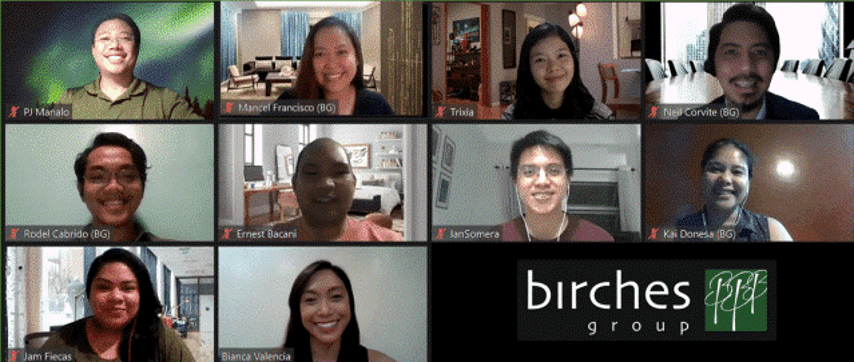
Group photo of our team ahead of the 15th Anniversary Party

Human Resources organizes regular “lunch and learn” sessions hosted by different teams and attended by staff from across Birches Group, as well as a session on mental health and wellness delivered by our medical insurance provider. We also shifted our learning content to a learning management system that is easily accessible to all staff online. These engagement initiatives boost morale and foster closer cross-team connections, and most importantly, strengthens our community.


Virtual work is the new normal. These may be unprecedented times but as you can see from our experience, virtual work is something doable and worth doing.

How is your organization coping with virtual work?  Please add your comments and questions below, and of course, reach out to us if we can assist your organization in operating in the virtual world!


PJ has been working with Birches Group since 2006. He currently leads Birches Group’s Manila-based Design & Strategy team which is responsible for developing Birches Group’s Community™ integrated HR platform, delivering consulting projects, conducting client training workshops/events, and developing strategic communications and marketing initiatives. PJ goes where the work and clients are, and to date, he has traveled to 33 countries for Birches Group.


There is an old expression: Man Plans, God Laughs. COVID-19 has brought into stark relief the true meaning of unpredictability. While some public health experts tried to warn us, most of us did not see this coming and despite our best efforts do not really know where this is going, at least for now. One area which is directly impacted is performance management.

Frustration with the traditional approach to performance management has been percolating through companies now for several years. Our general reticence to change often keeps us pursuing a course of action well past its true utility.  Now that we have been given a pretty good jolt from our everyday reality, it is a good time to take a step back and ask: how should we value performance through both the predictable life in the office and now the uncharted world of virtual work?

There is an underlying arrogance in the design of classic approaches to performance management that presumes we can articulate a structure of cascading objectives across the corporation linking everyone. Invariably, shortly into the performance year, these objectives must be tweaked and adjusted, and in many instances, ultimately set aside as the business encounters unanticipated challenges and opportunities. 

It is the Birches Group’s view that the weakness of traditional performance management is it has always missed a fundamental truth: It is not possible to have objectives detached from the purpose of the job. With a focus on purpose, the achievements in a job become readily apparent. I may not know what will happen next, certainly very true today, but I do know the purpose of my job, and with that knowledge I should be able to perform and support the broader activities of my unit and my company. It is as simple as that.

Work planning has its value but only against clearly understood purpose.  When inevitable bumps in the road are encountered, focusing on the purpose of the job is the compass that can steer us ahead. Take the case of the HR Director who every year has a different tactical mandate and different projects to oversee. The purpose of the job of the Director is to lead the function in securing talent to the organization’s mission and to safeguard the integrity of human resource management. This focus, this purpose, remains constant.

By focusing on purpose, issues related to how and where I work begin to fade in importance. This is true for jobs across all levels and especially important for ensuring coordination within a team and integration across teams. 

Another fundamental weakness in the more conventional approaches to examining performance is poorly articulated job design. Job descriptions start as little more than blank pieces of paper and managers, with little or no guidance, are asked to set down the reason a job exists. The results are usually vague, focused on inputs rather than outputs, and do not provide a transcending view across the unit let alone the company. The fact is, most managers and staff cannot articulate what distinguishes a job at one level from another. Is there any wonder why managers struggle to assess performance consistently, let alone have a clear understanding of purpose?

In our Community™ approach, we have tried to clearly highlight the milestones of purpose across all levels found in an organization. This framework not only provides a clear foundation for establishing equivalent worth across a multi-disciplinary workforce, it also answers, as applied to a work context, the most important of all questions: Why am I here?

The COVID-19 challenge provides a true moment for reflection. We would like to believe that in a few short weeks, maybe a month or two, we will get back to the way things were.  If so, we would have missed out on a watershed moment in how we approach work and the organization of teams, and how organizations can move from what are essentially workplace and workforce practices from the last century.  Instead, we should all be focusing on how we will continue operating in a new reality, leveraging the benefits of virtual work in place of our historical habits.

The pressure to enable virtual work forces us to be clear about purpose, to free our teams from classic command structures. It forces us to become better at communications since our teams will no longer just be sitting outside our door.  And yes, it forces us to focus on outcomes over inputs since work can no longer be defined as time spent in a particular place. 

Without a crystal ball, at Birches Group, we have been preparing for the world of virtual work for some time. In fact, we had a very robust work from home policy in place covering almost all staff when the impact of the virus began.  When we decided very early on in the crisis to go fully virtual, there were few hurdles to overcome. That is not to say there hasn’t been some nervousness over what the future may hold, but this nervousness has much less to do with our ability to deliver our services but rather, whether our clients will be able to adapt to these challenges. In future blog posts we will share our understanding about this new virtual world in which we all now find ourselves. It does demand above all else a change in mindset about what we understand as value in the workplace.  The challenge we face is great, but the opportunity is even greater.


Gary is the founding and managing Partner of Birches Group.  He has worked in the areas of organization design and compensation management for over forty years.  Following a career with the United Nations, Gary has led the Birches Group consulting practice working with many leading international organizations in over 100 countries.  Gary has pioneered a new simpler way to integrate job design with skills and performance through Birches Group’s Community™ platform.  He is recognized as a global expert on job theory and design delivering workshops and lectures around the world


Many years ago, when I was just starting as an HR Officer working in a large public institution, I had the opportunity to participate in a meeting that I found to be very instructive about life in a large bureaucracy. A senior manager had come to the HR Department to meet with the Director to discuss the career options of one of his long-serving staff.  In short, in the manager’s view, there were none. He used the term “deadwood” to characterize the quality of this staff member’s contribution to the team.  He had come to the HR Department so that we would do something to remove this burden from his unit.

Having now spent forty years working in HR, I have come to learn that one of the functions which we are expected to perform is to take out the trash.  In the above case, the HR Director responded thoughtfully.  He noted that the staff member in question had a long service record which, while not distinguished, was certainly solid.  He asked a simple question:  how did this staff member become dead wood? 

This is a blight that unfortunately is all too common in large institutions. In many of the training workshops I have conducted on job evaluation and organization design, at a certain point in the workshop I always ask the participants:  How did you feel on your first day of work? Since the participants were working in organizations that are highly mission driven and focused on great issues of public purpose, the responses were invariably the same: Proud, nervous, inspired, anxious to contribute, make a difference. I then would ask amongst the participants how many had served ten years or more. And how did they feel today?  Again, a set of responses with a great deal in common: Disappointed, detached, cynical and not particularly motivated.

Digging into these perspectives, we found the transition from inspiration to desolation was not related to levels of pay or benefits. So, what is it about these large institutions that can take a thriving group of bright, committed individuals and turn them into the petrified forest? Some of this can be linked to culture and the reality that comes with working in an environment that is often highly political. Another contributing cause is a failure of integrity in the day to day management of the institution. While these are not small issues, most staff over time are mature enough to understand that an organization created to address issues of public policy will be by its nature political. Failures of integrity are harder to live with, but fortunately have not been generally perceived to be pervasive. 

What is seen as the major reason for this decline in morale, the stultifying nature of the institution itself and how it manages staff. Dense bureaucracy with turgid processes that are impervious to change, uninspired managers who rose to their positions not based on merit or skill but rather mastery of the bureaucratic culture and most importantly a failure to recognize, nurture and challenge staff in their jobs. Job structures are rigid, you do the tasks enumerated on the job description and keep your head down. Time passes and if you still have a pulse a little more money is doled out with all the fanfare of receiving a bowl of gruel and not surprisingly receiving a level of gratitude equal to its appetizing nature.

Yet despite this sorry state of affairs, many staff still feel a strong sense of personal commitment. They may be disappointed in how they are managed. They are uninspired by their leadership. Some have cynically “checked out” and are hanging in for just what they can get. But they still want to know that their work matters and yearn for the day where that will be made more evident.

How can we turn this situation around? What is essential is to create a strong and personal link between the work of the individual and the mission of the organization. It is a mystery to me that perhaps the strongest asset of the organization, its inspiring mission, has been so poorly inculcated into the daily life of the workplace. It has squandered the very glue that binds the organization together. Small measures such as pictures of the work being done and regular briefings by organization leadership to all staff of the accomplishments in critical program areas are not hard to do but often just do not happen, and so even with us all working in the same building we become isolated and detached.

I know these measures can be powerful. One summer early in my career, I was an intern at NASA headquarters in Washington. This organization goes out of its way to connect all staff to its mission. Regular briefings, an inclusive culture, stunning pictures of its missions and personal expressions of gratitude from senior management and astronauts makes everyone know and feel that they had a part in getting the rocket off the pad. Although this was only a four-month assignment, it had a profound influence on my thinking about how an institution can behave. Beyond improving the general culture of the organization, it is essential that we rethink jobs and how they are designed. In the past posts a strong argument has been presented that the current approach of most organizations, with a focus on input over purpose blunts any hope to building a strong linkage of the person through the job to the mission. In our next post, we will show how organizations can make this transition.


Gary is the founding and managing Partner of Birches Group.  He has worked in the areas of organization design and compensation management for over forty years.  Following a career with the United Nations, Gary has led the Birches Group consulting practice working with many leading international organizations in over 100 countries.  Gary has pioneered a new simpler way to integrate job design with skills and performance through Birches Group’s Community™ platform.  He is recognized as a global expert on job theory and design delivering workshops and lectures around the world


In chemistry, an agent which accelerates a reaction is known as a catalyst.  Whether the impact of COVID-19 on the workplace will ultimately be catalytic or just a passing nuisance remains to be seen. However, all the elements for catalytic change in how we work are present. It is an evolution that has been slowly creeping over the workplace for over twenty years. Unfortunately, like all change, it has often been resisted, ignored, denied, and avoided, usually by management!

The imperative brought on by COVID-19, that we do something now to keep people working when they cannot leave their homes, is prodding even the most stodgy amongst us to look past, and perhaps even let go, of the traditional office workplace. Had this event occurred even thirty years ago, our choices would have been frighteningly limited. Thankfully, modern technology has come to the rescue.

The classic construct of the workplace, even the word itself, has been radically transforming now for years.  Is anyone doing “office work” of any kind today restricted or limited to what can only be done in an office building from nine to five, Monday to Friday?

These changes – shifting from a set workplace and workday to virtual work and work-life integration – have often been characterized as burdens, invasions into our personal space, a violation of a sacred separation between myself as a worker and my life as a person.  However, today, during a global economic downturn and worsening pandemic, those of us who find ourselves able to work virtually are counting our lucky stars and looking forward to receiving that continued paycheck. What will happen when COVID-19 just becomes another flu, just another illness that is treatable and no longer impeding social interaction? Even the scariest predictions anticipate that this point will eventually arrive. Will most of us retreat into the past and the comfort and familiarity of the office and the pleasant relationships we have nurtured over the water cooler?

Shame on us if we do!  The truth is we do not have to. The virtual work world has arrived and is not limited to the odd occasional day of working from home. Perpetual virtual work is a transformation which requires us to think differently about what we do and with whom we do it.  It requires a change in mindset about the value and purpose of our work, how jobs are designed and how teams are organized.

How to move forward

For an organization to embrace this new reality and be successful in the integration of virtual work into their work culture, the transformation must start with clarity of purpose – and that means clear, concise job descriptions and good organization design practices for team formation. There is a surprising lack of clarity in most modern organizations, and solving this issue is a requirement for a successful shift to virtual work.

Our job design approach uses the three factors to focus on job outputs – why something is done in the job and how the job is carried out. This results in the crafting of job descriptions with no more than six functional statements aligned to the grade of the job, linked to the Community™ job evaluation factors used to grade the job. There is much which is insidious about the traditional workplace which we all simply accept like we long accepted the divine rights of kings. To free ourselves from the 20th century mindset we must approach our work differently and our organizations must enable this change. The first step is to bring clarity, true clarity to the purpose of our jobs and how our jobs fit together in teams. Most of us are completely unaware of just how poorly organizations articulate job purpose today. What’s the symptom of this? Poor job descriptions.

Ultimately, this lack of clarity and consistency leaves staff and managers often in a fog about what is to be done is their work’s real purpose. This also inhibits freedom of action and leaves managers and staff timid to pursue work more independently, remaining huddled in the safety of the way things are versus trying out new approaches to get work done. It is necessary to become methodical in job design to bring the consistency and clarity that is needed to empower workers to excel and to complement one another.

What do we mean about methodical job design?  In Birches Group we have studied this challenge deeply.   To bring consistency to job design, it is necessary to create a template base structure which presents the components of the all jobs consistently.  We have developed such a framework based upon three elements or factors which distinguish/define the level of a job across the full spectrum of work found in any organization.  These three factors are:

  • Purpose – Why this job exists
  • Engagement – How the job interacts within the team and with outside clients and collaborators
  • Delivery – What is provided as the service ensuring timely provision and of a consistent quality

It is important to note that what distinguishes this approach to the current typical way job descriptions are developed is the focus.  In the Birches Group method, the focus is on outputs; why something is done in the job over inputs about how a job is carried out. This results in crafting job descriptions of no more than six functional statements aligned to the grade of the job values which are the foundation of the grade. Building this strong linkage between job functions and the grade of the position brings the clarity that is needed for both managers and staff to understand the purpose and how this is to be pursued as part of the team. 

Taking this approach provides another big pay off. By describing the outputs of a job over the inputs provides a ready reference for assessing performance.  At the time of the performance review only a simple question must be asked:  Was this accomplished?

The next part is easy.  With clarity we can work from anywhere.  For almost any position (and we would maintain for any office position with the appropriate technology enabled), the work can be carried out anywhere and at any time.  Leaving the office behind does demand a new etiquette in how we interact.  In Birches Group, for example, we do insist that we use cameras when talking with one another.  We need to be accessible to our teammates and clients and hopefully, find spontaneity in our interactions. 

Yes, some of these changes require new approaches by organizations to enable their staff.  We have reached a point in the evolution of communications technology where the investments are not daunting, and the payoffs can be significant.  More importantly, does anyone doubt that this is road from which no organization can turn away?  Yes, we must approach job design as the point of departure in articulating the new boundaryless organization, enable our work with technology, and think of new ways to measure our performance.  And all of this can happen… Because, now, we can.


Gary is the founding and managing Partner of Birches Group.  He has worked in the areas of organization design and compensation management for over forty years.  Following a career with the United Nations, Gary has led the Birches Group consulting practice working with many leading international organizations in over 100 countries.  Gary has pioneered a new simpler way to integrate job design with skills and performance through Birches Group’s Community™ platform.  He is recognized as a global expert on job theory and design delivering workshops and lectures around the world


Ok then, COVID-19 is not yet in the rearview mirror. Most of us are just trying to keep things going the best we can until we can get back to normal operations.  Will there be lessons learned from this experience or are we going to see this as a once-in-a-century phenomenon? We have presented in other posts that this moment can serve as a turning point…if we want it to.  It all comes down to how we think about the challenges social distancing and quarantine have posed in the organization of office functions.

We have tried to make the case that the biggest challenge to embracing the virtual world is not the technology but ourselves, our mindset about work and our subconscious need for control in the manner the traditional office with its vertical hierarchies and time/place dimensions. I often think that indeed this reticence is rooted in a fear akin to jumping out of an airplane for the first-time parachuting, an activity I must confess to have yet to try.  Yes, there are unknowns in going virtual. There is a risk of failure, perhaps not as bad as your chute not opening.  Most managers are very risk averse, and hardly anyone wants to go first. This is largely because we don’t know how or where to start.

To continue the analogy with parachuting, I am told the experience is delightful, quite liberating, a true sense of boundless freedom. From both the staff member and manager perspective, moving to a virtual relationship, perpetual or occasional, can have very similar attributes. The virtual world of work is supported by two pillars which distinguish it from the traditional office — trust, and a shared sense of responsibility. 

Not bound by time and place, it is fundamental that there is a strong bond of trust between the manager and staff member, and equally across the team. So much of the structure and nature of the traditional office is about control. While not many of us still must punch a clock on arrival and departure, there are usually articulated work hours where presence is required. What you are doing during those hours may not amount to a hill of beans but you must be there and be seen. 

There is an implicit assumption that presence equals work and commitment. Perhaps this assumption would not really survive intense scrutiny. In the virtual world, it all begins with trust. Trust that when given freedom, it will be returned with commitment. After forty years of working in office settings, I know presence does not equal work and I would not want someone on my team that I do not trust.

Without the shackles of the time clock linked to office presence, what is the stimulus to get something done? Working from home or elsewhere, would I not be goofing off all day like an unsupervised kindergarten class? Are we advocating some out there Montessori-approach to work? Yes, we are. The vertical hierarchies of the traditional office usually position staff in narrowly defined input-oriented functions. We not only told what to do, but how and when to do it. This places an enormous burden on the manager, robs the staff member of freedom of thought and finally, perpetuates the status quo in all things, slowing innovation and openness to anything new.

The workplace takes on characteristics of a prison with the manager as boss/warden and the staff members keeping their heads down and not rocking the boat. The job becomes defined as a number of hours you owe the company like a prison sentence you must serve every week to get paid.  It is not only a form of a physical prison but the traditional office structure is also a prison of the mind. Since this is the world we know, we are often hardly aware of its strictures. And like long serving inmates in any prison, over time we all become institutionalized and not only accept but take comfort in the narrow cells of traditional roles. 

It is often in vogue to talk about team empowerment. Lots of fancy talk usually without much to show in most organizations. And is there really any wonder why? Given the fundamental nature of the traditional office and its insidious character, an effort to build “empowered” teams is greatly stymied from the start. It is like trying to build a new engine on an antiquated design. Are we surprised why this engine fails to start?

The second pillar of the virtual world, shared sense of responsibility, is a natural outgrowth of the quality of the virtual approach. Since I do not have the boss looking over my shoulder, I must take responsibility for my work, exercise some freedom of thought and discipline to deliver outcomes that are the expectations of my job. The virtual organization counts on me to work this way, contributing not only my outputs but my ideas on how best to get the work done. It trusts that I will behave responsibly and work toward the purpose of my role, my team and my organization.

Making the leap from the traditional to the virtual does require as a first step that we think anew about how we define work and organizational structures. In his book, Utopia, Sir Thomas More noted:

“For if you suffer your people to be ill-educated, and their manners to be corrupted from their infancy, and then punish them for those crimes to which their first education disposed them, what else is to be concluded from this, but that you first make thieves and then punish them.”

We have raised our staff and indeed ourselves in this traditional structure which has in fact corrupted our thinking. We need to prepare our staff to work virtually, to overcome their “first education” about work. If we do not, they will only be prepared to be thieves and live up to our lower expectations, and we will find ourselves punishing them and ourselves at the same time.

Where do we begin? We first must recognize the reality of our legacy approaches. The traditional structure and its definitions of work and hierarchy present a segmented, segregated set of relationships:

  • The grading structure separates jobs and staff in rigid boxes which are difficult to cross. 
  • The detachment of job structures from learning and development programs fails to link growth in skills with meaningful career development and therefore, staff get stuck. 
  • The opaque and pseudo-scientific techniques which have long prevailed in job evaluation keeps managers and staff in the dark as to what is it about the job that places it in the level in which it is found.

For a virtual world to work, we must bring clarity.  Here is what it looks like:

  • Everyone must know why and how the grade structure works, and it should illuminate purpose and reinforce the value of contribution at each level. 
  • We must create stronger linkages between the growth in individual skills and the movement of staff through the grade structure, opening new career development opportunities. 
  • As a living entity, organizations must develop the capacity to recognize and reward skills growth within grades using milestone which mark a career path.
  • Like membranes of a cell in a living organism, grades must become permeable to permit passage from one level to another when certain conditions are met. 

This will create a virtuous circle of development and advancement, motivating for staff and optimizing organizational capacity as shown in the graphic below.

Again, not to sure where to start?  If I may return to my opening analogy about the first time someone jumps from an airplane.  It is a scary yet exhilarating experience. May we suggest the first time you take a tandem dive. We know how to build these structures, how to move from the rigid to the living. We have done it. If you let us, we can show you how to make this transition and how a truly virtual and empowered workforce can be created. In future blog posts we will begin to set down the road map and the tools for the journey.


Gary is the founding and managing Partner of Birches Group.  He has worked in the areas of organization design and compensation management for over forty years.  Following a career with the United Nations, Gary has led the Birches Group consulting practice working with many leading international organizations in over 100 countries.  Gary has pioneered a new simpler way to integrate job design with skills and performance through Birches Group’s Community™ platform.  He is recognized as a global expert on job theory and design delivering workshops and lectures around the world

  • 1
  • 2